
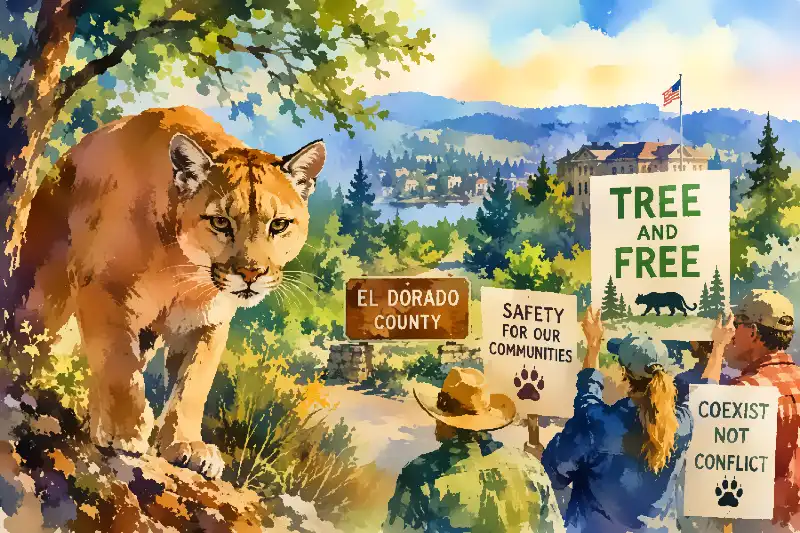
Mountain Lions Declared ‘Imminent Threat’ as El Dorado County Residents Push for ‘Tree and Free’ Program
Residents across rural portions of El Dorado County are again sounding alarms over mountain lion activity following renewed debate over public safety, livestock losses and California’s strict protections for the predators.
The issue has intensified after a Northern California sheriff recently declared mountain lions an “imminent threat to public safety” following repeated encounters near homes and rural communities.


In El Dorado County, concerns over mountain lions have remained high since the March 2024 fatal attack near Georgetown, where an 18-year-old man was killed and another person injured in what authorities described as the first fatal mountain lion attack in California in two decades.
Now, some local residents, ranchers and lawmakers are backing legislation that would allow trained houndsmen to haze mountain lions before attacks occur.
The proposed pilot program — known as “Tree and Free” — was introduced as Senate Bill 818 by Susan Talamantes Eggman and later associated with discussions involving regional lawmakers, including representation tied to El Dorado County interests. The proposal would authorize specially permitted houndsmen to track and tree mountain lions deemed potential threats to livestock, pets or public safety, then release the animals unharmed after hazing them away from populated areas.
According to the bill text, the program was intended as a five-year pilot project specifically for El Dorado County in order to collect scientific data on whether proactive hazing reduces conflicts between humans and mountain lions.
Supporters argue the program could restore mountain lions’ fear of humans without killing the animals.
“This is about prevention before someone else gets hurt,” one rural resident wrote in public commentary tied to the proposal.
California law currently classifies mountain lions as a “specially protected mammal” under Proposition 117, approved by voters in 1990. State law allows mountain lions to be killed only under narrow circumstances, including when officials determine an animal poses an “imminent threat to public health or safety.”
The California Department of Fish and Wildlife defines “imminent threat” as aggressive behavior directed toward a person that cannot reasonably be explained by the presence of emergency responders.
Wildlife officials continue to emphasize that mountain lion attacks remain rare despite increased public attention.
According to the California Department of Fish and Wildlife Mountain Lion Conflict Information, lions generally avoid humans but conflicts can increase where deer populations, livestock or unsecured pets attract predators closer to residential areas.
County officials have also published guidance encouraging residents to remove brush near homes, install outdoor lighting, secure pets at night and avoid feeding deer or other wildlife that may attract lions.
The debate has exposed a widening divide between wildlife advocates and rural residents.
Conservation groups warn that expanding aggressive hazing programs could increase stress on mountain lion populations and undermine decades of wildlife protections. Some advocates argue that expanding human development into foothill and forested habitats is contributing to more frequent encounters.
Meanwhile, ranchers and foothill residents say they are increasingly encountering lions that appear less fearful of people.
Recent online discussions among rural Californians have described sightings near homes, livestock areas and recreation trails throughout the Sierra foothills, including portions of El Dorado County.
Although SB 818 ultimately failed to advance during the 2025-26 legislative session, the controversy surrounding mountain lion management in El Dorado County appears far from over.
For many foothill residents, the question is no longer whether mountain lions belong in the region. The question is how communities and predators can safely coexist as encounters become more visible — and more personal.