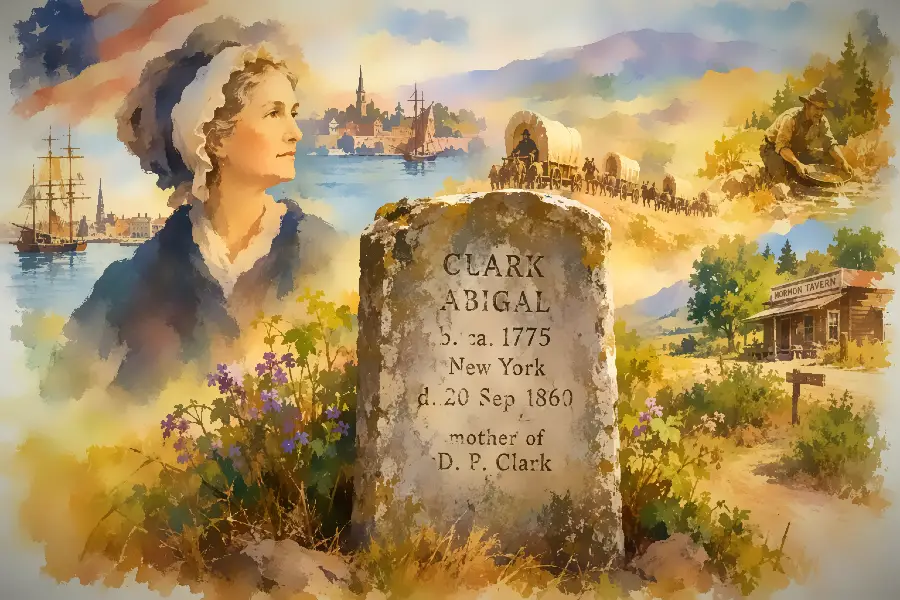
A Woman Born Before America: The Story Behind an Old Clarksville Grave
EL DORADO HILLS, Calif. — Sometimes the most remarkable pieces of local history are not found in museums, historical markers, or dusty archives.
They are found on a hillside, beneath an old stone.

Years ago, while walking through the Clarksville Cemetery — historically known as the Mormon Tavern Cemetery — a local visitor encountered one of those moments that can stop a person in their tracks.
Among the old headstones was one belonging to Abigale Clark, a woman whose dates place her birth around 1775.
That means Clark was born before the United States declared independence in 1776.
According to a transcription of the cemetery’s surviving legible gravestones, Clark died Sept. 20, 1860, at age 85. The inscription identifies her as a native of New York and states that she was the mother of D.P. Clark and grandmother of Mary E. Porter.
Born in a different America
The historical significance of Clark’s age is easy to underestimate.
If the cemetery inscription’s age of 85 is accurate, Clark was born approximately in 1775. New York was then one of Britain’s North American colonies.
The Declaration of Independence would not be adopted until July 1776. The Revolutionary War had already begun, but the nation that would eventually stretch from the Atlantic Coast to California did not yet exist.
Clark would have lived through the American Revolution, the creation of the United States government, westward expansion, the War of 1812, the Mexican-American War and the California Gold Rush.
She died in California only 12 years after the United States acquired the territory through the Treaty of Guadalupe Hidalgo and only about a dozen years after gold was discovered at Coloma.
That makes her grave more than an old marker.
It is a physical link between two very different Americas.
From New York to Gold Rush California
The surviving cemetery record does not establish the complete route Clark took from New York to California, and it would be premature to fill in those missing years with assumptions.
What is documented is that she eventually became part of the Clark family of the Clarksville area and was buried in what is now one of the historic cemeteries of El Dorado County.
The cemetery itself is deeply connected to the county’s Gold Rush-era transportation history.
The Clarksville Cemetery, located in present-day El Dorado Hills near U.S. Highway 50, was also known for a time as the Mormon Tavern Cemetery. A cemetery transcription conducted in 2004 recorded 80 burial entries, including Clark’s.
The Clarksville Region Historical Society notes that the cemetery was associated with the old Mormon Tavern, an important early roadhouse serving travelers heading into California.
A historical account prepared by the El Dorado County Pioneer Cemeteries Commission describes the Mormon Tavern as an early public inn serving immigrants traveling across the Great Plains toward Sacramento. The tavern was operating as early as 1848 and continued into the 1870s.
The cemetery sits on a hill overlooking the former tavern site.
Today, motorists traveling U.S. Highway 50 through El Dorado Hills can pass within sight of this remarkable piece of the county’s past without realizing what lies nearby.
A cemetery older than the county’s Gold Rush identity
The cemetery’s history reaches back to the earliest years of the Gold Rush.
Historical research by the Pioneer Cemeteries Commission documents deaths associated with the Mormon Tavern during the cholera epidemic of 1850. Among those buried there were Dr. Torrey and James Johnson, although their graves are no longer marked.
Other notable figures are also associated with the cemetery.
The Clarksville Region Historical Society identifies the cemetery as the burial place of Luther Brown Clark, one of the early settlers for whom Clarksville was named, although his grave is unmarked.
The cemetery also contains the grave of Samuel Elliott Kyburz, whose family was in California during the earliest years of the Gold Rush. The historical record notes that the Kyburz family crossed the plains and eventually reached California in time to witness the transformation brought by the discovery of gold.
And then there is Abigale Clark.
Her story is different.
She does not represent merely the Gold Rush generation. If the 1775 birth date implied by her 1860 age is correct, she represents a generation born before the American Revolution had even ended.
The human scale of history
There is something different about seeing history carved into a gravestone.
We can read that the United States was founded in 1776. We can study the Revolutionary War in school. We can look at paintings of George Washington and read about the Founding Fathers.
But an 1860 gravestone belonging to an 85-year-old woman makes the timeline personal.
Someone born in the colonial era lived long enough to cross the continent — or at least travel far enough west to become part of the California story — and ultimately came to rest in a small cemetery overlooking what had once been a Gold Rush road.
Her stone survived.
Her journey, however, remains largely undocumented in the easily accessible public record.
That is precisely why old cemeteries matter.
They often preserve the names of people whose larger stories have disappeared.
A question still waiting for an answer
The existing cemetery transcription identifies Clark as a native of New York, resolving one question that can easily arise when viewing the stone.
What remains unclear is exactly when she left New York, where she lived during the intervening decades and what route eventually brought her to California.
Those questions could potentially be answered through additional genealogical research, including federal census records, New York records, California voter or property records, probate files and contemporary newspapers.
For now, the gravestone provides the essential clue.
Abigale Clark was born around 1775 in New York and died in Clarksville in 1860.
She lived through the birth of the United States and died in a California community created by the great westward migration that followed the discovery of gold.
That is quite a journey for one name carved into an old stone on an El Dorado Hills hillside.
And it is a reminder that when El Dorado County residents walk past an old cemetery, they may be walking among people whose lives began long before California was a state — and, in Clark’s case, before the United States was a country.
Historical sources: The Clarksville Region Historical Society maintains historical information and cemetery materials concerning Clarksville and the Mormon Tavern Cemetery. Clarksville Region Historical Society — Clarksville Cemetery The cemetery’s gravestone transcription is also publicly available through Interment.net. Clarksville Cemetery records