

EDITORIAL | Nonpartisan — or politically aligned?
There is a legitimate political debate taking place in El Dorado County, but it is not necessarily the one being argued on social media.
The immediate controversy concerns the League of Women Voters of El Dorado County and a planned candidate forum for the Board of Supervisors District 4 race. The League announced that it would not hold the forum after Republican candidate Ted Gaines declined the invitation.
On Sept. 7, campaign representative Matt Cox declined on Gaines’ behalf.
League President Elizabeth Leslie-Gassaway said the organization was disappointed that voters might not have an opportunity to hear directly from Gaines or ask questions of the candidates.
“A candidate’s decision not to participate is ultimately their own,” Leslie-Gassaway said in the statement.
That sentence matters.
The League is correct that a candidate is free to decline an invitation. Gaines is equally free to decide which campaign appearances he believes are worthwhile.
But the episode raises a different question: What should a supposedly nonpartisan organization do when one candidate refuses to participate?
The answer is not obvious.
The forum itself is not the controversy
Candidate forums are useful democratic institutions. They give voters an opportunity to compare candidates under substantially similar circumstances and hear answers to questions selected for public discussion.
That is especially relevant in District 4, where Gaines advanced from the June primary with 46.89% of the vote. Gina Posey received 25.59%, Greg Clark 18.98% and Robert J. Deitz II 8.40%, according to the official El Dorado County election results.
The November general election is scheduled for Nov. 3.
So, yes, voters deserve opportunities to hear from the candidates.
But that does not automatically mean the League’s response to Gaines’ refusal is beyond criticism.
Some local commenters argued that the forum should have proceeded with Posey rather than being canceled. Others criticized Gaines for declining to participate.
Those are both legitimate political opinions.
The more consequential issue is whether voters should regard the League itself as politically neutral.
Nonpartisan does not mean apolitical
Here is where the public discussion frequently becomes muddled.
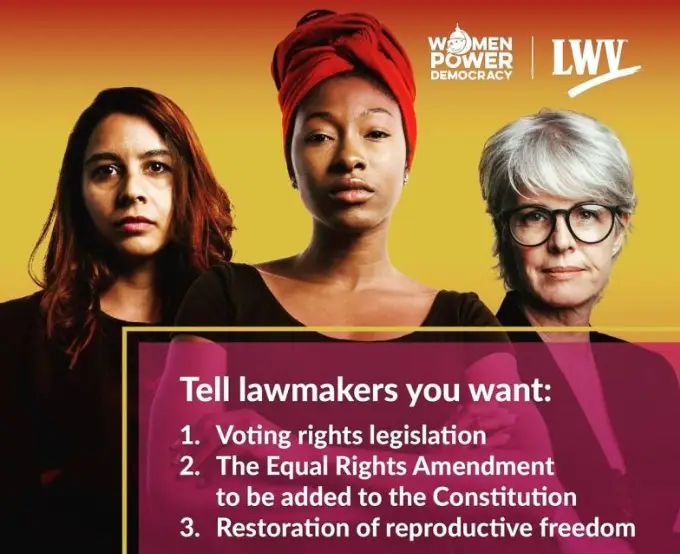
The League of Women Voters explicitly describes itself as nonpartisan. Its national organization says it does not support or oppose political parties or candidates. At the same time, it makes clear that the organization engages in political advocacy on issues it believes are consistent with its adopted positions.
That distinction is not a secret.
The League of Women Voters of California describes advocacy as part of its organizational work and provides local Leagues with resources for taking action at the local and state levels.
The national League also publicly advocates positions involving voting rights, reproductive rights, health care, environmental policy and other issues. For example, the organization states that it supports a constitutional right to make reproductive choices and advocates for access to abortion.
In 2026, the League’s national communications continue to emphasize reproductive rights and voting rights as issues in which it is actively engaged.
Those positions are plainly political in the broad sense that they concern public policy.
But that does not make the League a political party, nor does it establish that the El Dorado County chapter supports Democratic candidates.
That distinction should be respected.
The real credibility test
The better question for El Dorado County voters is not:
“Is the League secretly a Democratic organization?”
There is insufficient evidence to make that assertion as fact.
The better question is:
“Can an organization advocate strongly for particular public-policy positions and still be trusted to conduct candidate forums fairly and impartially?”
The answer can be yes.
In fact, that is precisely what the League says it does.
Its stated position is that it can advocate for issues while remaining neutral among candidates and political parties.
That is a meaningful distinction — but it also creates a higher standard for transparency.
If an organization wants the public to trust its forums as neutral voter-education events, voters have every right to examine its rules, moderators, questions, candidate invitations and procedures.
That scrutiny should apply regardless of whether the candidate involved is a Republican, Democrat, independent or something else.
The League’s statement deserves scrutiny, too
The League’s Sept. 9 announcement was factual in describing its outreach to Gaines.
But it also went beyond simply announcing a canceled event.
The statement emphasized the loss of an opportunity for voters and characterized the candidate’s absence as a “missed opportunity to inform voters, foster meaningful civic engagement, and encourage voter participation.”
That is advocacy for participation in the League’s forum.
It is not necessarily improper.
But neither should voters be discouraged from asking whether the same language would have been used if the candidate declining the invitation had been a Democrat.
That is the appropriate standard for a nonpartisan organization.
Same candidate. Same rules. Same treatment.
Political labels are easy. Transparency is harder.
Some comments responding to the League’s announcement described it as “far left,” “socialist” or politically biased. Those are opinions, not established facts, and they should be identified as such.
Likewise, describing Gaines’ decision as evidence that he is unwilling to answer questions is an interpretation unless supported by a broader record of his campaign activities.
Political journalism should resist the temptation to turn both sides’ rhetoric into fact.
The League’s own public materials demonstrate that it has substantive policy positions. They also demonstrate that the organization distinguishes those positions from candidate endorsements and partisan political activity.
Both facts can exist simultaneously.
The issue for voters is whether that distinction is credible when the organization is conducting a candidate forum.
El Dorado County voters deserve more than political branding
El Dorado County’s electorate is not monolithic. As of Sept. 4, the county reported 137,303 active voters: approximately 42% Republican, 29% Democratic and 19% with no party preference, with smaller numbers registered with other parties.
That makes credibility particularly important for any organization presenting itself as a neutral source of election information.
The League does not need to abandon its policy positions to earn that credibility.
Gaines does not need to accept every invitation to demonstrate that he is willing to engage voters.
But both sides should understand the public’s right to ask questions.
For the League, the question is whether its candidate forums are demonstrably neutral despite its broader policy advocacy.
For Gaines, the question is why he chose not to participate and whether voters will have another opportunity to question him directly.
And for voters, the responsibility is simpler:
Don’t outsource your judgment to either side.
Read the League’s materials. Read the candidates’ statements. Watch the public meetings. Ask questions. Examine the record.
And when someone invokes the word nonpartisan, don’t treat it as a political magic word.
Ask what it means.
Then look at what the organization actually does.
That is not partisan.
That is informed citizenship.