
Alarcon: District 4 Race and Measure S Face Different Political Tests
As El Dorado County voters prepare for the Nov. 3 general election, political strategist Cris Alarcon sees a fundamental difference between the race for the District 4 seat on the Board of Supervisors and the countywide Measure S sales tax proposal.
Both contests face the same electorate, but Alarcon argues that the supervisor race already has a measurable electoral baseline. Measure S, by contrast, must establish whether voters support the proposed tax and its stated public-safety and hospital priorities.

The distinction centers on what the June primary results reveal — and what they do not.
Primary results give Gaines a substantial advantage
The June 2 primary established Ted Gaines and Gina Posey as the two leading candidates for the District 4 supervisor seat. According to the El Dorado County Elections Department’s final summary report, Gaines received 7,159 votes, or 47.1%, while Posey received 3,761 votes, or 24.7%.
Gaines led Posey by 3,398 votes, finishing with approximately 1.9 times her vote total. Although Gaines did not secure an outright majority, the results gave him a substantial lead heading into the general election.
The race also reflects a broader question for local campaigns: How much can candidates change voter preferences between the primary and the general election?
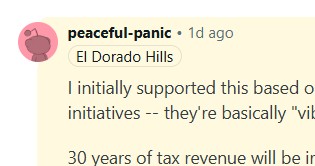
In a political comment addressing the contest, Ken Bennett wrote: “Mr. Gaines knows the voting block far better than we do. If he thinks he can easily win” — adding, “I’m sure he’s correct.”
Bennett also compared that perceived advantage with the position of Measure S proponents.
Alarcon offered a similar assessment of the supervisor race, arguing that many voters who made their choice in June are unlikely to change their minds in November.
“Yes, the Primary determined this race,” Alarcon said. “Those that voted either way for the County Supervisor 4th District had made up their minds and will vote the same this time. So it is just the fence sitters.”
Alarcon said he had not seen anything significant that would change the likely outcome. He characterized the primary margin as a formidable obstacle for Posey to overcome.
What the numbers say — and what they cannot predict
Alarcon’s assessment rests on the size of Gaines‘ initial lead and the likelihood that established voter preferences will persist.
He argued that overcoming a two-to-one deficit between a primary and a general election is historically and statistically difficult.
The official results support the central point that Gaines entered the general election with a substantial advantage. They do not, however, establish that the race is already decided.
Gaines received approximately 47.1% of the vote, not a majority. Posey received approximately 24.7%, while Greg Clark and Robert Deitz II accounted for much of the remaining vote in the four-candidate primary.
Those results leave several variables for the general election, including turnout, campaign spending, voter engagement and the ability of either candidate to attract voters who supported other candidates in June or did not participate in the primary.
Alarcon acknowledged that a different outcome remains mathematically possible, while arguing that the size of Gaines’ lead indicates substantial existing support.
“While it is mathematically possible,” Alarcon said, “a lead of that magnitude usually signals that one candidate has insurmountable institutional support, funding, and baseline voter alignment.”
He described the strategy for a candidate holding such an advantage as allowing the existing lead to carry through the general election.
“Time will tell as to this normal pattern plays true,” he said.
That is a political forecast, not a verified conclusion about the eventual result. The November vote will determine whether the primary’s pattern holds.
Why Measure S presents a different challenge
Alarcon draws a distinction between a candidate contest and Measure S, a countywide ballot measure scheduled for the Nov. 3, 2026, election.
Unlike the supervisor race, Measure S does not enter November with a June primary vote establishing its level of support. Its appearance on the general-election ballot will give voters their first opportunity to decide whether to approve the proposed countywide sales tax.
The El Dorado County Elections Department describes Measure S as a proposal to enact a three-eighths-of-1% sales tax for 30 years, projected to generate approximately $390 million.
According to the county’s ballot language, the proposed revenue would support hospital facilities, equipment and technology; help maintain local emergency-room access; support fire protection and wildfire prevention; and provide rapid 911 responses to fires, accidents and medical emergencies.
The proposal also includes independent oversight, audits and local control, according to the county’s published measure description.
These stated purposes will be central to the public debate, alongside questions about the cost to consumers, the tax’s 30-year duration and whether the anticipated revenue justifies the commitment.
For supporters, the measure presents an opportunity to fund services they consider important to the county’s long-term safety and health care. Opponents and undecided voters may weigh the proposed tax against household costs, competing priorities and confidence in the proposed oversight provisions.
The county’s published ballot language establishes what Measure S proposes to do. It does not establish whether voters agree with those goals or will approve the tax.
Alarcon summarized the difference directly: “Measure S is different. It is untested in voter preference.”
The November test for El Dorado County voters
The two contests will ultimately be decided by voters, but the campaigns face different strategic circumstances.
In District 4, Gaines’ strong primary showing provides a measurable starting point. Posey must either maintain her existing support while attracting additional voters or persuade some primary voters to reconsider their choices.
For Measure S, supporters and opponents face a different task: convincing voters to make a decision on a proposal that did not appear on the June primary ballot.
That distinction matters throughout El Dorado County, where residents will be weighing candidates for local leadership alongside a proposal affecting sales taxes and funding for hospitals, fire protection and emergency response.
The June results provide a factual basis for assessing the supervisor race. They do not guarantee its outcome, just as the purposes listed in the Measure S ballot language do not guarantee public approval.
The central question heading into Nov. 3 is whether the primary’s established voting patterns will persist in District 4 — and whether Measure S can win enough support to pass its first test before countywide voters.
Sources and public records
Editorial note: The statements attributed to Ken Bennett and Cris Alarcon are drawn from the supplied commentary. Bennett’s full statement and the original publication context were not independently verified. Alarcon’s predictions are presented as political analysis rather than established facts.