EL DORADO COUNTY, Calif. — A photograph captured at a Northern California military base more than five decades ago became one of the defining images of the Vietnam War era.
Its photographer, Slava “Sal” Veder, spent his final years in El Dorado County.

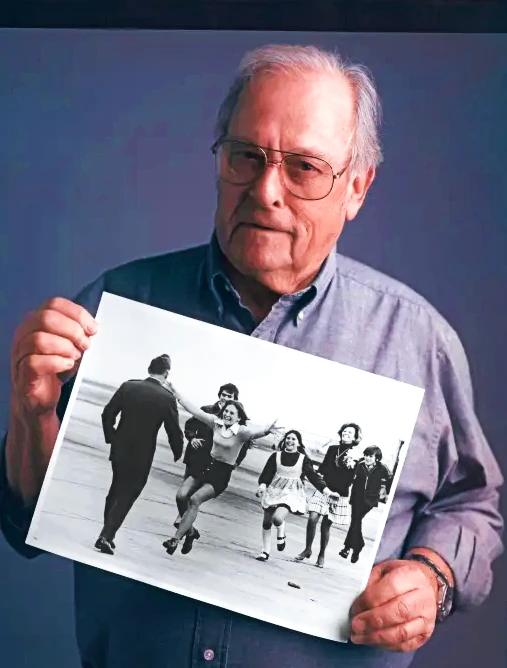
Veder, the longtime Associated Press photojournalist whose 1973 photograph “Burst of Joy” won the 1974 Pulitzer Prize for Feature Photography, died Aug. 22 at his El Dorado County home. He was 99.
His family confirmed that Veder died peacefully in his sleep, just eight days before his 100th birthday.
For residents of El Dorado County, the death is the quiet passing of a man whose professional life was anything but quiet. Veder photographed California and national history for decades, from political figures and protests to some of the most closely watched criminal and political cases of his era.
But his name remains inseparable from one photograph.
A moment of homecoming at Travis Air Force Base
On March 17, 1973, Veder was among dozens of photographers at Travis Air Force Base in Fairfield awaiting the arrival of American prisoners of war returning from Vietnam.
Veder was 46 and working for the Associated Press. In the crowded press area, he noticed four children running toward their father, Air Force Lt. Col. Robert L. Stirm, who had spent five years as a prisoner of war in Vietnam.
Veder raised his camera.
The resulting image showed Stirm walking toward his family with his back to the camera as his children rushed forward, their faces filled with excitement.
The photograph became known as “Burst of Joy.”
Veder later recalled the instant he recognized what was happening.
“You could tell, even at a distance, what they were feeling.”
He added that there was “a surge of emotion” among the crowd. Veder made six photographs of the scene after working from a makeshift darkroom inside a women’s bathroom at the base. “Burst of Joy” ultimately won the Pulitzer Prize for Feature Photography.
The image became a powerful visual representation of American troops returning home and the closing chapter of U.S. involvement in Vietnam.
Behind the joy was another story
The photograph’s emotional power has endured in part because of what cannot be seen in the frame.
While Stirm’s children ran toward their father, Stirm himself was returning to a family life that had changed dramatically during his captivity.
A military chaplain had given him a letter from his wife, Loretta, upon his release. The couple divorced the following year.
Stirm died in 2025 at age 92.
That complicated history became an important part of the photograph’s legacy. What appeared to be an uncomplicated celebration of a soldier’s return also contained the private consequences of years of war and separation.
A California journalist’s career
Veder was born Aug. 30, 1926, in Berkeley to Russian immigrants Ivan and Anka Veder. He began his career as a sports writer and news editor before joining The Associated Press as a staff photographer in 1961 at its Sacramento bureau.
He later transferred to the AP’s San Francisco office.
Over the course of his career, Veder photographed former California Gov. Ronald Reagan, anti-Vietnam War demonstrations, the Patty Hearst trial and the 1978 assassinations of San Francisco Mayor George Moscone and Supervisor Harvey Milk.
He retired from the Associated Press in 1993.
His work extended beyond the famous image. Colleagues remembered Veder as a photographer who understood that a compelling photograph required more than simply pressing the shutter.
Retired AP photographer Eric Risberg described Veder as an important mentor who emphasized the relationship between photography and reporting.
“He really, really emphasized the marriage between pictures and words,” Risberg said, recalling Veder’s advice to look deeper into what the actual story was.
A quiet final chapter in El Dorado County
The national obituary reports place Veder’s final home in El Dorado County, outside Sacramento, bringing the story of a Bay Area-born photographer back to the broader Northern California region where much of his career unfolded.
That local connection adds another chapter to the life of a journalist whose photographs traveled far beyond California.
Veder was remembered by former colleagues as warm, humble and generous with younger photographers. Brad Mangin, a freelance sports photographer from the San Francisco Bay Area, recalled the significance of meeting a Pulitzer winner who remained approachable.
“He was just the sweetest man,” Mangin said.
Veder is survived by three of his five children, eight grandchildren and 12 great-grandchildren, according to the Associated Press.
The photograph that outlived the photographer
“Burst of Joy” endures because it freezes a fraction of a second that millions of people can understand without knowing the circumstances surrounding it: children running toward a parent who has finally come home.
The photograph was taken at Travis Air Force Base in Solano County, but its legacy became national and international.
Now, more than 53 years after Veder made that frame, the photographer himself has become part of the history he spent his career documenting.
Sal Veder died in El Dorado County on Aug. 22, eight days before reaching the century mark.
He leaves behind a Pulitzer Prize, an extraordinary body of work and one photograph that remains instantly recognizable — a burst of joy preserved forever in time.
Sources: The Associated Press obituary and reporting; KCRA; KPBS; The Washington Post.