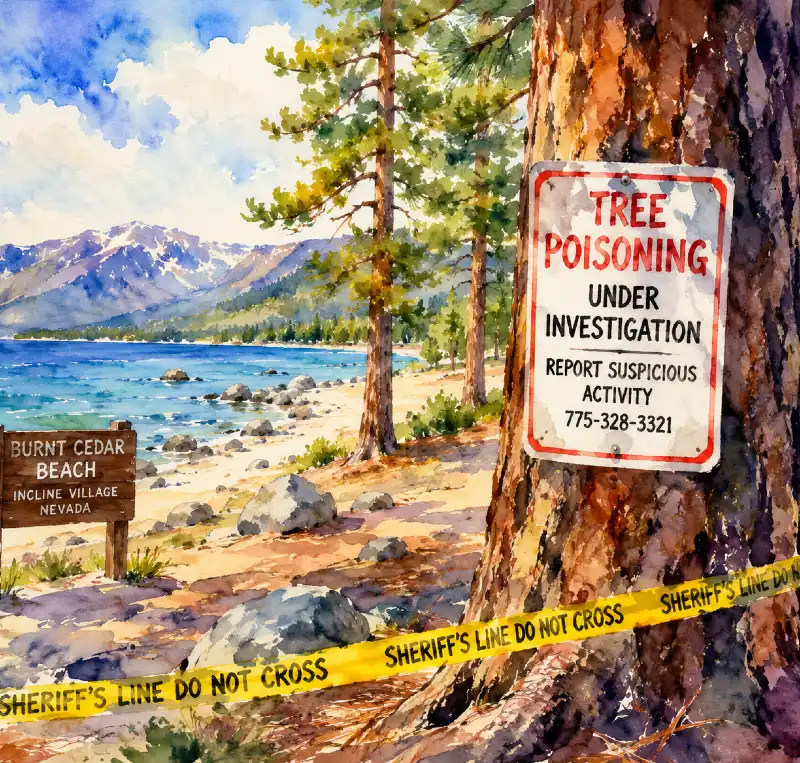
INCLINE VILLAGE, Nev. — A series of apparent tree poisonings at a Lake Tahoe beach has escalated into a criminal investigation, with authorities seeking information about whoever has repeatedly targeted mature pine trees along the North Shore.
The investigation is centered at Burnt Cedar Beach in Incline Village, on the Nevada side of Lake Tahoe — not in the city of South Lake Tahoe or El Dorado County.

That distinction matters for local readers, because the incident is nevertheless part of a larger Lake Tahoe environmental story affecting communities throughout the basin, including South Lake Tahoe, Meyers, South Shore and the western slope of El Dorado County.
16 trees affected in latest incident
The Washoe County Sheriff’s Office says investigators responded after substances were discovered around the bases of trees at Burnt Cedar Beach. Soil samples collected during the investigation reportedly had an odor similar to material encountered during earlier tree-poisoning incidents at the property.
The latest incident is believed to have occurred between approximately 11:30 a.m. Aug. 1 and 5 a.m. Aug. 2. A trail camera recorded a brief light in the area at approximately 2 a.m., giving investigators a potentially important piece of evidence as they attempt to establish who was present.
Authorities have not publicly identified the substance used to damage the trees.
Capt. Joseph Colacurcio of the Washoe County Sheriff’s Office said investigators are examining a pattern that extends back several years. Six trees were affected in 2022, another six in 2024 and 16 in the latest incident, according to reporting from SFGATE. That brings the reported total to approximately 28 trees.
The financial loss is also substantial. Colacurcio estimated the damage from the repeated incidents at more than $300,000, while emphasizing that mature trees along the lakefront are difficult, if not impossible, to replace on a comparable time scale.
Sheriff: “Deeply troubling”
Washoe County Sheriff Darin Balaam described the apparent destruction as a serious community concern.
“The deliberate destruction of these trees is deeply troubling and represents a significant loss for the entire community.”
Balaam said investigators are taking the repeated incidents seriously and urged anyone with information to come forward.
At this point, authorities have announced no suspect and no established motive.
That makes it particularly important to distinguish confirmed evidence from speculation circulating online. Investigators have not publicly attributed the attacks to a particular property owner, homeowner, development interest or other individual.
Earlier trees largely died
The damage is not merely cosmetic.
According to IVGID spokesperson Paul Raymore, all six trees affected during the 2022 incident ultimately died. Five of the six trees targeted in 2024 also died.
The Incline Village General Improvement District, which operates Burnt Cedar Beach, has brought in environmental specialists to assess the affected trees and surrounding soil and determine whether additional damage can be prevented or mitigated. The district also is working on measures intended to discourage another incident.
Burnt Cedar Beach remains open, and officials have said there is no immediate threat to visitors.
Why El Dorado County should pay attention
For residents of El Dorado County, the story carries significance beyond the Nevada state line.
Lake Tahoe is a single interconnected watershed divided by two states and numerous governmental jurisdictions. Environmental problems on one portion of the shoreline can have implications for the broader basin, where agencies routinely coordinate on forest health, water quality, wildfire resilience and scenic resources.
That shared environmental responsibility is especially relevant as South Lake Tahoe and the surrounding Tahoe Basin continue to deal with the consequences of drought, wildfire and forest mortality.
The California Tahoe Conservancy, for example, is carrying out forest-health and wildfire-resilience projects in the Tahoe Basin, including a 25-acre project in Tahoma involving Conservancy, U.S. Forest Service and El Dorado County properties. The project is intended to improve forest resilience and reduce wildfire risk in the wildland-urban interface.
The contrast is striking: public agencies are spending millions of dollars and coordinating across jurisdictions to protect and restore Tahoe’s forests, while someone appears to have deliberately damaged mature trees in a recurring series of incidents.
A Tahoe history of tree poisoning
Intentional tree poisoning is not without precedent in the Lake Tahoe Basin.
Archived records from the Tahoe Regional Planning Agency document earlier cases in which trees were deliberately poisoned to alter views of Lake Tahoe. In one case investigated by TRPA, holes were drilled into mature Jeffrey pines and herbicide was applied. TRPA determined the trees had been intentionally damaged without agency approval.
Another TRPA case involved salt poisoning that ultimately contributed to the death and removal of numerous mature trees that had obstructed scenic views from a residence.
Those historical cases provide context, but they do not establish a motive in the current Burnt Cedar Beach investigation.
Officials have cautioned against speculation while investigators work to determine exactly what happened.
Investigation continues
The Washoe County Sheriff’s Office is asking anyone who witnessed suspicious activity around Burnt Cedar Beach during the relevant period or who may have security-camera footage to contact investigators.
The current investigation is being conducted under case No. 26-4225. Authorities have asked witnesses to reference that number when providing information.
For El Dorado County residents who regularly travel between the South Shore and North Shore, the incident is another reminder that Lake Tahoe’s environmental resources do not stop at a county, city or state boundary.
The trees at Burnt Cedar Beach may stand on the Nevada side of the lake. But the larger environmental question — how communities protect Tahoe’s aging and increasingly vulnerable forests — is shared by everyone who calls the Tahoe Basin home.
Editor’s note: This report refers to the current investigation at Burnt Cedar Beach in Incline Village, Nevada. It should not be characterized as a tree-poisoning investigation occurring in South Lake Tahoe, California, or El Dorado County.
Sources: Washoe County Sheriff’s Office statements as reported by the San Francisco Chronicle and SFGATE; Incline Village General Improvement District; Tahoe Regional Planning Agency archival records; California Tahoe Conservancy.