
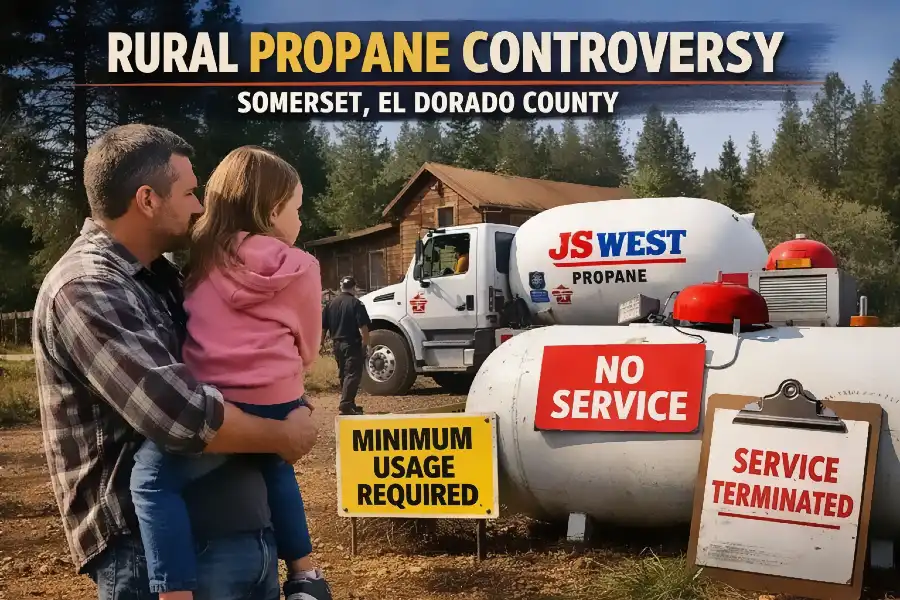
SOMERSET, Calif. —
A Somerset tenant’s claim that his propane supplier threatened to discontinue service over low usage is drawing attention across rural El Dorado County, where many residents rely on propane as a primary energy source.
Gary Johnston, a single father renting a home in Somerset, said he was informed by his landlord on April 18 that JS West Propane would no longer deliver fuel to the property. According to Johnston, the reason given was insufficient annual propane consumption.


“They will no longer supply propane to my daughter and I, simply because we have not purchased enough propane to satisfy their financial needs,”
Johnston wrote in a public post shared with community members.
“That’s ridiculous to me.”
The company has not publicly responded to Johnston’s specific claim. However, industry practices across California often include minimum usage requirements tied to leased propane tanks — a common arrangement in rural areas where suppliers retain ownership of the equipment.
Industry Practices Under Scrutiny
Propane providers typically lease tanks to customers at low or no upfront cost, recouping expenses through fuel purchases over time. Experts note that minimum usage thresholds are sometimes included in service agreements to ensure profitability, particularly in low-density regions where delivery logistics can be costly.
Residents in El Dorado County say Johnston’s experience is not unique.
Several community members reported similar situations involving different suppliers, citing annual minimums ranging from 250 to 300 gallons. Others described switching to privately owned tanks to avoid contractual limitations.
“You are definitely way better off buying your own tank,”
one local resident wrote.
“That’s what we did so you can be competitive and buy from whomever has the best price.”
Rising Costs and Seasonal Pricing
The complaint also renewed criticism over seasonal propane pricing. Like many heating fuels, propane costs tend to rise during colder months due to increased demand — a dynamic widely described by suppliers as standard market behavior.
Still, some residents question the fairness of those fluctuations, particularly for households attempting to conserve energy.
Johnston expressed frustration with what he described as a system that penalizes lower consumption.
“People are doing whatever they can to survive and conserve,” he wrote.
Consumer Options and Considerations
Energy experts say customers who purchase their own propane tanks may gain flexibility in choosing suppliers, though upfront costs can be significant. Ownership also requires maintenance, certification, and compliance with safety regulations.
Local residents emphasized the importance of keeping documentation of tank ownership and understanding service agreements — especially when buying or renting property.
Broader Implications
The issue highlights a recurring challenge in rural communities like Somerset and greater El Dorado County: limited energy infrastructure and dependence on private fuel providers.
As conversations continue online and among neighbors, Johnston said his household plans to transition to a privately owned tank — a move he believes will provide greater control over energy costs and supply.
“I do whatever necessary to conserve,”
he said.
“We’re just trying to live our lives as best we can.”