By Cris Alarcon, InEDC Writer. July 20, 2026)
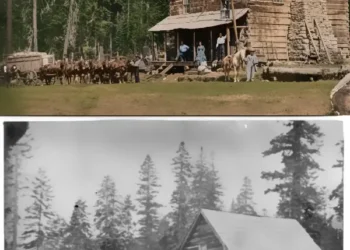
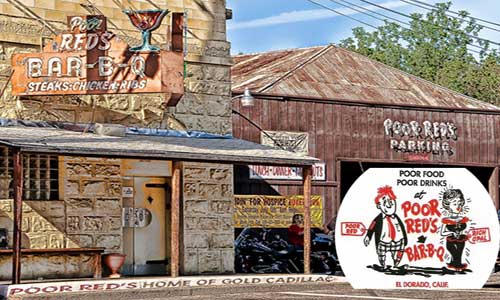
If the old stone walls of Poor Red’s could talk, they’d likely ask you to pull up a chair, pour yourself a Golden Cadillac, and listen close. They’ve been standing on Pleasant Valley Road since 1856, when pioneer physician Dr. Marcus D. Hinman built them. They’ve watched stagecoaches give way to automobiles, served as a Wells Fargo office, a gas station, Kelly’s Bar, and finally the place generations would simply know as Poor Red’s.

By the time my family wandered into Pleasant Valley, the old building had already become a legend.
We had just left South Lake Tahoe for the Western Slope in 1974. While my mother searched for a permanent home, we rented one of the two little white houses just east of Poor Red’s at 6243 Pleasant Valley Road. To me, it felt as though we had moved next door to the Wild West.
Poor Red’s wasn’t just the neighborhood restaurant.
It was our dining room.
My father was the chef at Harvey’s famous Top of the Wheel overlooking Lake Tahoe, making the mountain commute every day! Fine dining was simply how our family lived. Yet even with all of that, there was something about Poor Red’s that no white tablecloth could ever match. The smell of oak smoke drifted through El Dorado long before you reached the front door to wait for a seat to eat you waited in the Bar, and once you stepped inside, every stranger seemed like someone who might tell you the best story you’d ever hear.
Three memories have stayed with me for more than fifty years.
The first was the food. Everyone remembers the ribs, the steaks, and the chicken—and rightly so—but I remember falling in love with those bright red pickled beets that always seemed to find their way beside the barbecue. More than half a century later, one bite of a pickled beet still carries me back to that old stone building.
The second memory belonged to the cattlemen.
Once a week the ranchers gathered around the tables like kings holding court. These were the men who raised the beef that landed on everyone’s plate. They’d compare herds, swap stories, argue over cattle prices, and settle business with a handshake instead of a contract. As a little boy, I didn’t understand much of what they were saying, but I knew I was watching something important. It wasn’t just lunch—it was the heartbeat of the Western Slope.
Then there were the weekends.
You didn’t need a calendar if you lived next door to Poor Red’s.
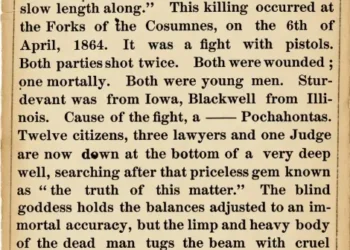
Friday nights announced themselves sometime after midnight. Saturday nights got started a little earlier, around ten. The music would stop, voices would rise, the front door would burst open, and another honest-to-goodness fistfight would spill into the street.
Not shouting.
Not pushing.
Real fists.
The kind where two hard-headed men settled their differences with bruised knuckles, dusted themselves off, and often came back the following weekend to have another drink together.
From our front yard, I had ringside seats.
For one wide-eyed kid, it was better than television.
Years later I came to know one of Poor Red’s greatest storytellers.
My mother knew Opal, who recruited me into the Business and Professional Women’s Club because they were one member shy of the minimum needed to keep the chapter alive. Thanks to that twist of fate, I spent time listening to Opal’s remarkable stories, and she had plenty. 
My favorite was the one about the dead man.
According to Opal, someone discovered a body lying beside the bar one morning. She looked at Red and snapped, “Get that body out of here!”
Before long, the unfortunate fellow had somehow been moved.
Not long afterward, the body was discovered again…
This time closer to the cemetery.
Whether every word was gospel truth or polished by years of retelling never really mattered. Every legendary saloon deserves at least one ghost story, and Poor Red’s had earned several.
My friend Joey Ferguson remembers the place much the same way. His father, Donald, brought him there often during the early 1970s. Joey still remembers his first rack of ribs and washing them down with a Roy Rogers while the grown-ups enjoyed Poor Red’s famous Golden Cadillac. Like me, he discovered that some flavors never leave you, no matter how many years pass.
That’s the thing about Poor Red’s.
It was never just a barbecue joint.
It was never just a bar.
It was the kind of place where ranchers, lumber workers, mechanics, miners, families, and travelers all gathered beneath one weathered roof. Deals were made over steaks, friendships were forged over cocktails, children discovered lifelong favorite foods, and every old-timer had one more story worth telling.
Today, the cattlemen have mostly ridden into history. The fistfights have faded into memory. Opal’s voice is silent, and many of the people who made Poor Red’s famous have saddled up for their final ride.
But the old stone building still stands.
And if you listen carefully while the smoke drifts from the barbecue pit and laughter echoes through the room, you might just hear the whispers of the frontier—the clink of a whiskey glass, the laughter of cowboys, the crack of fists out in the street, and the voices of old friends who never really left.
Because places like Poor Red’s aren’t built with stone alone.
They’re built with stories.
And stories, like good barbecue smoke, have a way of lingering long after the fire has burned low.