By Cris Alarcon, InEDC Writer. Aug 7, 2026
Before Placerville, there was Hangtown
Walk along Main Street in downtown Placerville today and it can be easy to forget how quickly the community emerged from the wilderness.
Brick buildings, historic storefronts and established streets give little indication of what stood here during the earliest years of the California Gold Rush.
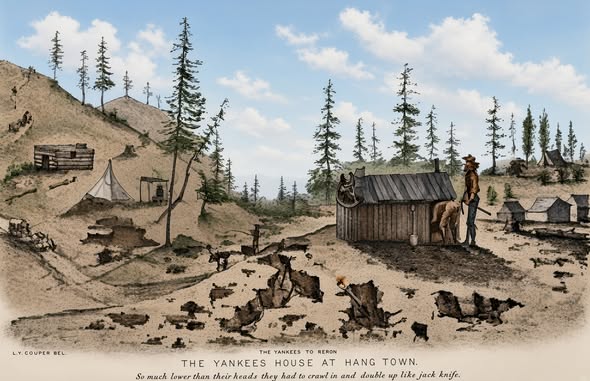
Then there is an image such as “The Yankees house at Hang Town.”
The small hand-colored lithograph, preserved by the University of California, Berkeley’s Bancroft Library, shows a settlement that looks far removed from the Placerville residents know today. Several log cabins and tents occupy the landscape while miners approach a remarkably low-roofed shack. Holes dug into the foreground underscore the mining activity surrounding the settlement.
The image carries an almost comical caption:
“so much lower than their heads, they had to crawl in and double up like jack knives.”
The humor was unmistakably intentional. But behind the joke was a serious reality: Gold Rush miners often lived with very little infrastructure, comfort or permanence.
A firsthand window into Gold Rush California
The image was created by George Victor Cooper, an artist who traveled through California with John M. Letts, the author of A Pictorial View of California. John Cameron transferred Cooper’s drawings to lithographic stone.

Berkeley’s Bancroft Library identifies the work as a Cooper/Cameron lithograph dating to about 1852. The original inscription identifies Cooper as the artist and Cameron as the person who put the image “on stone.”
The image subsequently appeared as Plate 24 in Letts’ A Pictorial View of California, published by Henry Bill in 1853. The book contained 48 lithographed plates illustrating California, the Panama and Nicaragua routes and scenes associated with the Gold Rush.
Letts was not writing from a distant armchair. He had traveled to California in 1849, reached San Francisco on July 4 and worked in the gold fields before eventually returning east. His book was intended to give readers an account of what he had personally encountered in the new California.
That makes the illustration particularly valuable today. It is not simply a romanticized depiction of the Old West. It is part of a visual record produced during the Gold Rush itself.
Was this really how miners lived?
Yes — although the Yankee’s cramped shack should be viewed as one stage in the rapidly changing housing conditions of Gold Rush California.
When the first wave of fortune seekers arrived after gold was discovered at Sutter’s Mill in January 1848, established communities and housing were almost nonexistent in many mining districts.
Miners initially relied heavily on tents and other temporary shelters.
California State Parks’ recreation of an 1852 mining camp at Coloma State Historic Park illustrates that reality. The state describes early mining camps as places where tent and shanty towns sprang up almost overnight, with merchants, restaurants, laundries, boarding houses and other businesses developing around the miners.
At Coloma, the progression from temporary camp to permanent settlement can still be seen in the historical record. California State Parks describes the community’s early population as living among log cabins and canvas tents after gold discoveries attracted thousands of people.
That context makes Cooper’s illustration especially revealing.
A log shack was not necessarily the beginning of a miner’s experience. In many cases, it represented an attempt to create something more substantial after the miner had decided to remain in one location.
The Yankee’s House, in other words, could be viewed as an improvement — primitive, but more permanent than sleeping beneath canvas or in the open.
From mining camp to Placerville
The settlement depicted in the lithograph was still known as Hang Town, a name associated with the violent and improvised justice of the early mining camp.
The City of Placerville’s historical account traces the community’s origins to the Gold Rush that followed James Marshall’s discovery at Sutter’s Mill. By the summer of 1848, miners were already moving throughout the surrounding region. The settlement that developed along Hangtown Creek became known as Dry Diggins before acquiring the more notorious nickname Hangtown.
The transformation was remarkably fast.
By 1854, the community had become one of California’s largest towns. That year, it was incorporated as Placerville — a name intended to provide a more respectable identity for an increasingly established community.
The National Park Service now recognizes Placerville as a Gold Rush town and notes its significance as both a California National Historic Trail and Pony Express National Historic Trail site. The Old Dry Diggins/Old Hangtown site is also recognized as a state historical landmark.
The NPS describes the original settlement as a “rich mining camp” from which millions of dollars in gold were taken and which became a supply and transportation center for surrounding mining communities.
The buildings changed. The story remained.
The transition from crude shelters to permanent buildings was driven by more than comfort.
It reflected a fundamental change in the character of the community.
A miner expecting to leave in a few weeks had little reason to build a substantial dwelling. A miner who intended to remain for years had a different calculation. So did merchants, hotel operators, restaurant owners and other entrepreneurs who realized that thousands of miners represented a permanent market.
California’s Gold Rush settlements therefore developed with extraordinary speed.
Tents gave way to shanties. Shanties gave way to cabins and commercial buildings. Boarding houses and hotels followed as communities became more permanent.
Placerville followed that trajectory.
The City of Placerville notes that the city was nearly destroyed by a major fire in 1856. The subsequent rebuilding helped produce the more substantial town that residents and visitors associate with historic Placerville today.
Among the surviving reminders of that transformation is Gold Bug Park, where visitors can still experience a portion of Placerville’s mining history. The city describes the park as a place where visitors can step back into the mid-19th century and experience what it was like to be a Gold Rush miner.
A tiny cabin with a big story
For modern El Dorado County residents, “The Yankees house at Hang Town” is more than an amusing old picture.
It captures the moment when a temporary mining camp was beginning to become a community.
The miners entering the tiny structure were not living in the Placerville of today. There was no mature downtown, no established civic infrastructure and no permanent city surrounding them.
There was gold, uncertainty, hard labor and the expectation that fortune might be just one more shovel strike away.
Their shelter reflected that uncertainty.
The cabin was crude because the community itself was still crude. Its absurdly low roof was funny enough to inspire a joke about miners crawling inside and folding themselves “like jack knives.” But the image also records something historically important: people were beginning to put down roots.
Within only a few years, Hangtown would officially become Placerville.
Today, the city’s historic streets and surviving Gold Rush landmarks provide physical reminders of that transformation. But images such as Cooper’s lithograph provide something the buildings cannot — a glimpse of the people and living conditions that existed before the permanent structures were built.
For those who live in El Dorado County, that may be the most fascinating part of the picture.
Placerville did not begin as the historic town we know today. It began with miners, tents, crude cabins and a gamble on gold.
And one of those miners’ cabins was small enough that its occupants apparently had to crawl inside.
Historical sources
The original lithograph is held by the Bancroft Library at UC Berkeley, which provides the catalog record, image information and original inscription.
The 1853 edition of Letts’ A Pictorial View of California is available through digitized historical collections, while the 1852 edition is available through Project Gutenberg.
The City of Placerville provides historical accounts of Hangtown, Placerville’s incorporation and the city’s development.
The National Park Service documents Placerville’s Gold Rush significance and its historic-trail designations.